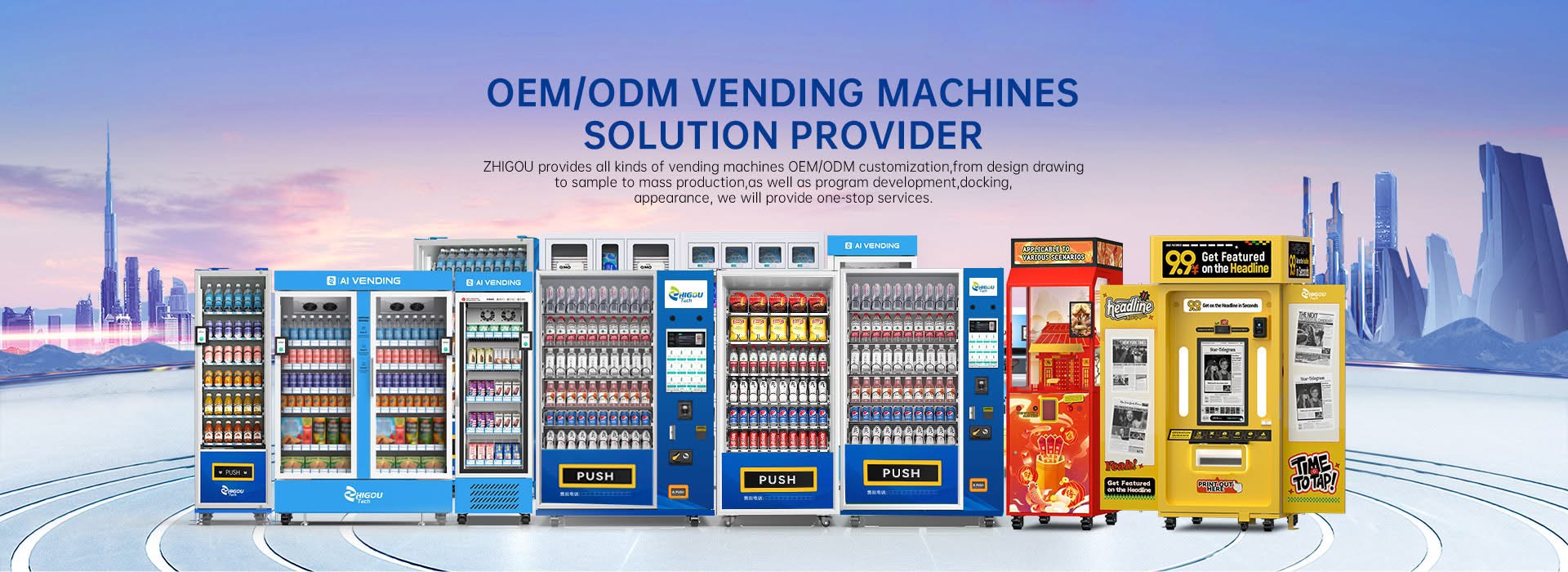
For operators planning to deploy unmanned retail vending machines, AI vending machines and spiral vending machines are two common options. The key difference between the two goes beyond simply “one being smarter and the other more traditional”; it extends to multiple aspects, including the shopping process, product compatibility, loss prevention, operational methods, equipment costs, and suitable scenarios. Coil vending machines follow the traditional “pay first, then take your items” model, with products dispensed through individual product channels; AI-powered vending machines, on the other hand, operate on an “authorized door opening, self-selection, and door-closing checkout” model, allowing consumers to freely select products as if they were entering a small convenience store. So, which one is better suited for your business? The answer depends on your product type, target customers, deployment scenarios, and your priorities regarding security and the consumer experience.
What is a Spiral Vending Machine?
The spiral vending machine is a mature mechanical unattended retail terminal, widely adopted in the vending industry for decades. It adopts a “pre-payment then dispensing” closed sales mode. The core delivery component is an independent spiral spring lane. When customers select goods and complete payment, the motor drives the spring to rotate and push commodities into the pickup tray. Customers cannot touch the goods inside the cabinet before payment, which greatly reduces shrinkage risk. Supported by a SaaS background system, the coil vending machine automatically records orders, sales volume, and inventory data. Equipped with a refrigeration module, it mainly sells standardized packaged snacks and beverages. Spring vending machine supports diversified payment methods, including cash, coins, card swiping, and QR scan. Its advantages lie in stable mechanical structure, controllable cost, and high security of goods and funds, while it has inherent limitations such as the risk of goods jamming and restrictions on commodity shapes.
What is an AI Vending Machine?
AI vending machine, also known as an AI open-door vending cabinet, is a new-generation intelligent unmanned retail device. It applies AI visual recognition + patented gravity sensing dual-recognition technology, cloud algorithm, and IoT control system. It runs on the logic of authorization to unlock the door, free selection, and automatic settlement after the door closes. Operators set the pre-authorization freeze amount in advance. After customer authorization, the cabinet door unlocks. Shoppers can pick multiple items freely. Once the door is closed, the system identifies the goods taken and deducts payment automatically. It breaks the limitation of fixed spring lanes, supports wider commodity types, and helps lift average order value by stimulating impulse consumption. AI-powered vending machine also integrates intelligent hardware such as a UPS emergency power supply, variable frequency refrigeration, and PDC heating, realizing intelligent temperature control and power failure protection.
AI Vending Machine VS Spiral Vending Machine
Differences in Core Operating Principles
1. Traditional Spiral Vending Machines: A closed-loop sales model where payment is made before the product is dispensed
Spiral vending machines are mechanical, fixed-point dispensing devices that operate on the principle of “upfront payment, passive dispensing, and isolated product retrieval”. The machine uses independent spring-loaded chutes to hold products of fixed specifications. After a customer completes an online order or makes an in-person payment, the system triggers the motor of the corresponding chute. The rotational thrust of the spiral pushes the product down into the retrieval opening, completing the transaction cycle. Throughout the entire transaction process, the products inside the cabinet remain in a sealed, isolated state, and consumers cannot directly touch the merchandise. All order data, dispensing records, and inventory data are synchronized in real time to the backend management system. The coil vending machine’s operation relies heavily on its mechanical structure and fixed product chute layout.
2. AI vending machine: An Open-Style Sales Model Featuring Self-Selection, Self-Pickup, and Automatic Settlement Upon Closing the Door
The AI-powered vending machine employs a new retail intelligent logic of “authorized door opening, free selection, and settlement upon closing the door”. Relying on patented dual-recognition technology—AI visual recognition combined with gravity sensing—and paired with a cloud-based algorithm system, the AI vending machine revolutionizes the fixed dispensing model of traditional vending machines. After consumers complete identity authorization and have funds pre-frozen, the cabinet door automatically opens, allowing them to freely select multiple items for an immersive shopping experience. The moment the door closes, the AI smart vending machine rapidly identifies the product categories, specifications, and quantities through its dual-recognition system, completing automatic checkout in 3 seconds. It deducts the actual purchase amount and unfreezes the remaining balance—all without any manual intervention, resulting in a highly flexible and intelligent shopping process
.
II. Comparison of Core Advantages
1. Spiral Vending Machines: High Stability, Low Losses, and Robust Risk Control
After decades of market evolution, spring vending machines feature a mature and reliable mechanical structure, with a low failure rate and extremely low operational and maintenance costs. Their enclosed dispensing mechanism physically isolates products from contact risks, resulting in the industry’s lowest rates of product damage and theft, ensuring exceptional security for both funds and merchandise.
The coil vending machines are designed for standardized packaged goods, feature a low entry barrier, and have controllable procurement costs, offering significant value for money. They are ideal for startup operators, those with limited budgets, and businesses seeking stable returns and low operational risks in their commercial deployment. Additionally, the spiral coil vending machine is highly scalable and compatible with a full range of payment methods—including paper bills, coins, card swiping, and QR code scanning—making it suitable for deployment across multiple regions and scenarios.
2. AI Vending machine: Superior User Experience, High Average Transaction Value, and Broad Compatibility
AI smart vending machines break through the limitations of traditional vending machines, which dispense only a single item. Their open shopping environment closely mimics the in-store experience of a convenience store, effectively stimulating impulse purchases and significantly increasing both the average transaction value and overall sales per square foot.
The spiral vending machine does not rely on fixed spring-loaded product chutes, eliminating product jamming issues. They support a wider range of products, enabling the mixed sale of multiple categories such as snacks, beverages, and daily necessities, while maximizing storage capacity utilization. Equipped with industry-leading AI algorithms (98.6% recognition accuracy), a patented gravity detection system, smart refrigeration, constant-temperature heating, self-cleaning, and smart charging capabilities, the spiral coil vending machine offers comprehensive upgrades in intelligence, scenario-based functionality, and durability.
III. Challenges in Equipment Operation
Spiral Vending Machines: Focus on Product Channels and Mechanical Dispensing
The daily operation of the coil vending machine primarily focuses on the product channels, springs, motors, and dispensing openings.
Operators need to regularly check whether the product channels are functioning properly, whether products are arranged according to specifications, and whether there are any instances of product jams.
AI Vending Machine: Focus on Product Recognition and System Operations
In addition to restocking and equipment maintenance, the daily operation of an AI-powered vending machine requires attention to product recognition, product cataloging, display standards, and abnormal orders.
For AI smart vending machines, consistency between product information and actual displays is crucial. When operators manage products according to established standards, it helps the system maintain more stable recognition performance.
Therefore, if your core objectives are to control costs, reduce inventory loss, and ensure stable sales of standardized products, spiral vending machines may be a better fit; if your goals are to enhance the shopping experience, expand product offerings, promote cross-selling, and increase average transaction value, AI vending machines may offer greater advantages.
V. Differences in Hardware Configuration and Performance
Spiral vending machines with control cabinets can be equipped with payment accessories such as bill acceptors, coin acceptors, card readers, and QR code scanners based on project requirements. They offer a wider variety of configurations and can be customized with different product chutes and screens, providing high flexibility for hardware expansion.
Spring vending machines with external screens and AI smart vending machines primarily use electronic payment methods such as card swiping or QR code scanning. Specific payment methods and card reader configurations can be determined based on the requirements of different countries, regions, and projects.
Therefore, if the market where the project is located still has a high demand for cash payments, coil vending machines with control cabinets can provide more flexible payment configurations.
IV. Precise Identification of Suitable Scenarios
Scenarios Suitable for Spiral Vending Machines: These spiral coil vending machines are best suited for standardized, unmanned environments with high security requirements, strict inventory control, and consistent purchase frequency. Such settings include various primary and secondary schools, college campuses, industrial parks, gated office complexes, and construction site living quarters. In these settings, sales primarily consist of standardized beverages and snacks, where the focus is on low risk, stable returns, and minimal operational and maintenance demands. Spring-loaded vending machines offer the best value for money.
Suitable Scenarios for AI Vending Machines: AI smart vending machines are best suited for upscale situations with lots of foot traffic, frequent purchases, an emphasis on the shopping experience, a demand for a large selection of goods, and a focus on environmental quality. High-end office buildings, star-rated hotels, gyms, business parks, corporate and government offices, and apartment complexes are some examples of these. AI vending machines can successfully increase overall income and improve the location's reputation in situations where users have a high rate of impulsive purchases and a strong propensity to spend.
Comparison Dimension | Spiral Vending Machine | AI Vending Machine |
Core Shopping Flow | Pay first, then dispensing; spiral coil trays push out products one by one | Authorize to open door → customer self-selects → automatic settlement upon door close (convenience-store-like experience) |
Shopping Experience | Closed; the customer can only take the single dispensed item | Open; customers can directly see and pick up multiple items |
Pilferage / Shrinkage Risk | Low: customers cannot touch all products; they only take the dispensed item after purchase | Present: customers can directly handle products; abnormal behavior or recognition errors may cause losses |
Funds & Product Security | High: pay-before-dispense; backend records orders and sales data | Medium: relies on AI recognition and backend monitoring; abnormal orders require manual/system intervention |
Maturity & Cost | Mature structure, relatively controllable cost, high cost-performance ratio | Newer technology; ROI acceptable for large operators with sufficient sales volume |
Average Transaction Value (ATV) Potential | Lower: only one dispensed item can be purchased | Higher: open layout encourages impulse add-ons (e.g., buying a bottle of water may lead to grabbing bread/snacks), lifting ATV |
Product Compatibility Range | Limited: oversize, fragile, soft-packaged, or irregularly shaped products may not fit; it depends on the coil tray size and angle | Broad: does not rely on spiral coil dispensing; supports multi-category products with regular packaging that are AI-recognizable |
Dispensing / Jam Risk | May jam: product size, placement angle, and tray mismatch can affect dispensing | No jam issue, but recognition accuracy is not 100%: glare, abnormal placement, ambient light changes, sensor interference, etc., affect recognition |
Shelf-Stocking / Operational Requirements | Emphasize product selection, continuous arrangement, uniform backward tilt, and trial selling | High: AI recognition depends on product images, packaging differentiation, and standardized display; must strictly follow onboarding photos and product specifications |
Suitable Scenarios | Unattended locations such as schools, factories, offices; first-time deployment, limited budget, standard product categories; customers who prioritize product security and strict site management | High-frequency scenarios such as offices, hotels, gyms, campuses/parks, locations with a rich product mix, and strong impulse purchasing |
Main Disadvantages | ① Potential jamming; ② Limited product categories | ① Shrinkage exists; ② Recognition not 100%; ③ High stocking requirements |
Mitigation Methods | ① Emphasize product selection, continuous arrangement, uniform tilt, and trial selling; ② Recommend door-opening cabinets, grid lockers, or belt/pusher solutions | ① Shrinkage: control via surveillance, backend anomaly orders, pre-freeze amounts, and product norms; ② Recognition: emphasize technical boundaries in training, make no absolute promises; ③ Stocking: strictly follow onboarding photos and product specifications |
Conclusion: Which is better?
There is no definitive “better” option between the two types of machines; what truly matters is which one best suits your products, usage scenarios, and operational goals. Spiral vending machines and AI vending machines represent two distinct approaches to unmanned retail. Coil vending machines emphasize “precise dispensing, stable operations, and inventory control,” while AI-powered vending machines emphasize “freedom of shopping, intelligent recognition, and multi-category sales.” For operators, rather than simply comparing which type of equipment is more advanced, it is better to conduct a comprehensive evaluation based on product types, deployment scenarios, budget, target customer base, loss control, and average transaction value targets. If your business primarily features standardized products and you seek a stable, low-risk operating model, spiral coil vending machines are a solution worth considering; if you hope to create a shopping experience closer to that of a convenience store and boost consumer spending potential through a wide range of products and an open shopping environment, AI smart vending machines may be a better fit for your unmanned retail business.