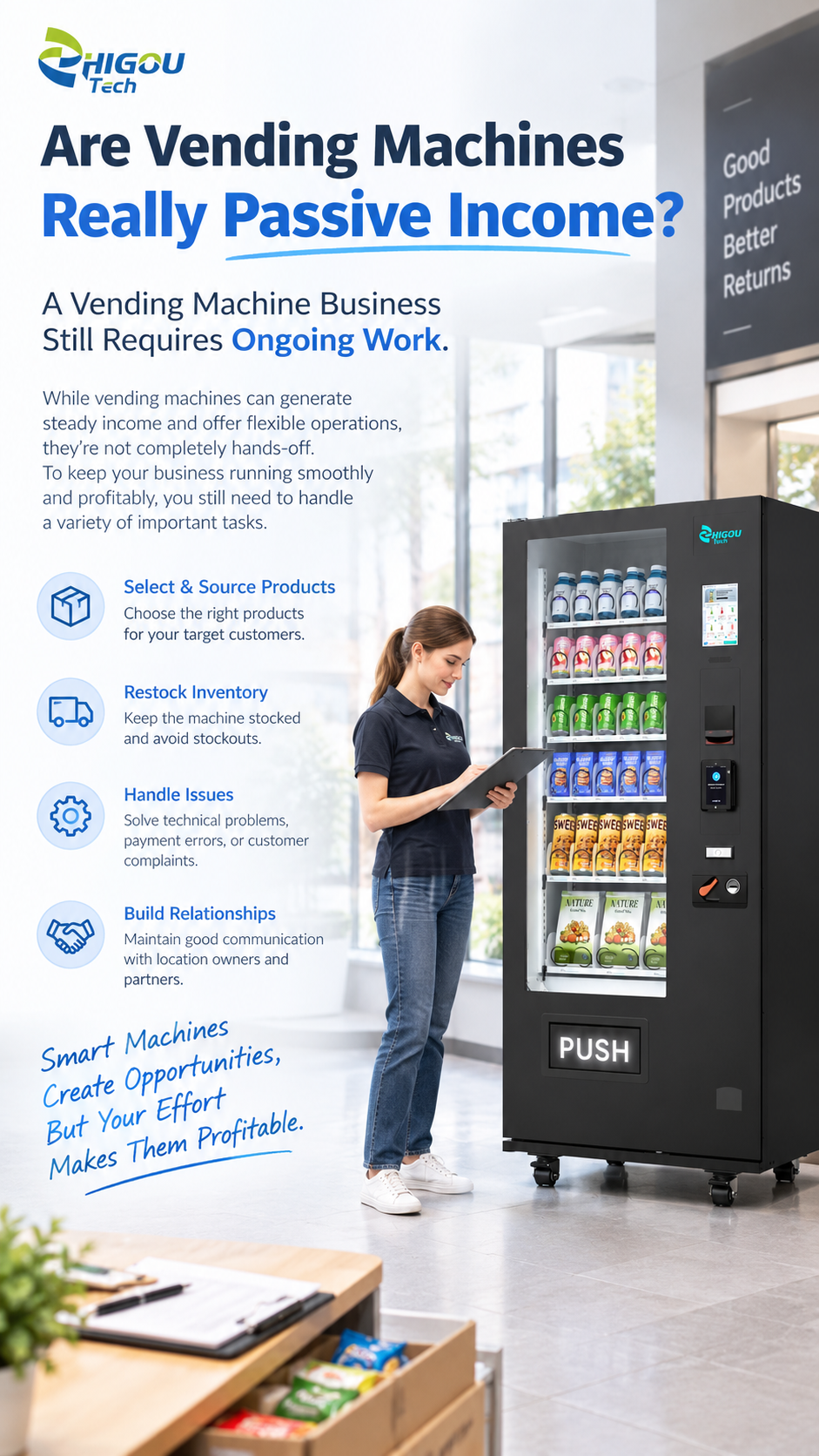
The appeal of vending machine passive income is easy to understand: a machine can complete a sale without an operator standing beside it. That does not make the business self-managing. Someone still has to choose products, buy stock, refill the machine, resolve problems, and maintain the relationship with the location. For a prospective owner, the useful question is how much work the operating arrangement leaves with you—and whether you can consistently perform or pay for that work. A [Reddit discussion about vending as a side business] explicitly challenges the passive-income description. It is an individual argument, not an audited industry study. Rather than treating its financial claims as benchmarks, examine the tasks behind your own proposed operation.
If you want to learn more about starting a vending machine business, you can read another article in our column: How to Start a Vending Machine Business?
A Vending Machine Business Still Requires Ongoing Work
Separate the customer transaction from everything that enables it.
| Activity | What the equipment may handle | What still needs an assigned person |
| Selling a product | Payment and dispensing, according to the configuration | Product selection, pricing, setup, and purchase exceptions |
| Monitoring stock | Sales or inventory reporting where supported | Checking records, ordering goods, and replenishing shelves |
| Detecting problems | Supported status or fault alerts | Assessing the problem, arranging access, and completing repairs |
| Customer support | Displaying contact information or a support route | Investigating complaints and handling refunds |
| Site management | Operating within the agreed setup | Maintaining permissions, access arrangements, and service communication |
Features vary by machine and platform. A function demonstrated on one configuration should not be assumed to exist on another.
Buying Stock and Refilling Machines Require Planning
Replenishment starts before you reach the machine. You need to decide what to order, check what is already in storage, receive deliveries, and prepare the stock for each location.
Use product-level records to distinguish items that need frequent replenishment from those that remain unsold. A cabinet can look well stocked while the products customers want are unavailable. Conversely, buying more of a slow-moving item ties up money without solving that gap.
At each visit, compare the physical stock with the records. Check product condition and relevant dates, rotate stock appropriately, and record removals rather than treating every missing item as a sale.
For food and drinks, plan cleaning and product-storage procedures around the goods and equipment involved. Follow the applicable product instructions and site procedures; a sales dashboard does not establish that a cabinet is clean or that its contents have been handled correctly.
Track the Full Cost of Each Service Visit
Include preparation, loading, travel, parking, access delays, restocking, cleaning, and recordkeeping when reviewing your workload. Counting only the time spent opening the machine leaves out much of the job.
For day-to-day vending machine operations, keep a simple service log showing what you brought, what you removed, what required attention, and what needs to happen next. It gives a substitute operator something more useful than a verbal instruction to “check the machine.”
Route Planning Is an Important Part of Vending Machine Operations
A location has to fit both its customers and your service arrangements. Before accepting it, confirm when you can enter, where you can unload, and whether the person servicing the machine needs an appointment or an escort.
Think through the trip for an ordinary refill and for an unexpected fault. A site that fits a planned route may still be difficult to reach when another commitment prevents you from leaving.
Compare locations using actual service records as they become available. Track travel, time on site, stock movements, and unresolved issues alongside sales. That helps you see whether an apparently attractive placement creates work your current setup cannot support.
Repairs and Payment Problems Need a Response Plan
A machine can stop delivering the expected service even when it remains powered on. A product may fail to dispense, a reader may lose connectivity, or a customer may need help understanding a transaction.
Decide who receives these reports and what information they need. Useful details include the machine identifier, time, selected product, and the customer's description of the problem. Use the payment provider's support process rather than asking customers to send sensitive card information.
For technical faults, agree on an escalation route with the equipment or service provider. Clarify what can be diagnosed remotely, when an on-site technician is needed, who arranges parts, and how the site will be kept informed.
Do not promise an immediate repair merely because you can acknowledge a message immediately. Keep service commitments consistent with the support you have actually arranged.
Revenue Is Not the Same as Vending Machine Profit
When assessing a claim of vending machine passive income, ask what the financial report actually measures. A sales total tells you what was sold under that report's definitions. It does not, by itself, show the result after product costs, site charges, payment costs, travel, repairs, and paid labor.
A separate [community question about recurring costs] asks specifically about connectivity, payment processing, and platform charges. Those are sensible items to request in a written quotation; the discussion does not establish a standard rate for your equipment.
To assess vending machine profit, review fixed charges, transaction-related charges, and occasional costs separately. Include your own working time in the operating review, even if you are not paying yourself a separate wage. Otherwise, an arrangement that requires substantial personal effort can appear almost effortless on paper.
Inventory and Cash Need Separate Attention
Buying stock uses cash before all of that stock has sold. Unsold goods remain inventory, and goods removed because they are damaged or unsuitable need to be recorded.
Also reconcile the sales records with refunds, payment deductions, and actual settlements. Money shown as sales is not necessarily money already available in the bank. For cash-accepting equipment, include collection and reconciliation in the routine.
The aim is to understand both the business result and the money available for the next order or service bill. Avoid treating the entire sales balance as money you can take out.
What Remote Monitoring Can and Cannot Do
Where supported and correctly configured, remote reporting can help you decide what to bring on a visit and which machine needs attention. It may reduce visits made solely to inspect stock or check status.
Outsourcing Changes: Who Does the Work
- Which information comes from measured stock and which is calculated from transactions.
- How refills, removals, refunds, and manual adjustments affect the records.
- How you can tell whether the data is current.
- What happens when connectivity is interrupted.
- Which alerts require a person to take action.
Remote visibility can support decisions. It cannot physically refill a shelf, remove damaged goods, clean a spill, or settle a disagreement with a location manager. Assign an owner to each alert rather than assuming that receiving it means the problem is being handled.
Understand the Workload Before Expanding Your Vending Business
You may outsource parts of your vending machine operations, such as replenishment, cleaning, repairs, or equipment management. That can reduce your direct involvement, but it adds a service relationship to manage.
Specify the work, access arrangements, reporting, charges, and process for missed visits or unresolved faults. Ask what happens when the usual person is unavailable.
Also clarify who controls the customer-support channel, who approves refunds, and who speaks to the location. Two parties each expecting the other to act can leave a simple issue unresolved.
Check completed work against the agreed service, and keep the records accessible. Delegation works better when the task and its completion criteria are clear.
Questions to Ask Before Adding Another Machine
If you are evaluating a vending machine business for sale, ask for service logs, maintenance records, and the arrangements with each location alongside the sales figures. Clarify which tasks the seller performs personally and which paid services would continue after a transfer. These are questions for checking the workload, not evidence that a particular offer is worthwhile.
Before adding another machine, review the operation you can actually support:
- Who orders and prepares stock?
- Who covers planned visits and unexpected problems?
- Who monitors product condition and cleaning?
- Who reconciles sales, refunds, fees, and settlements?
- Who maintains the relationship with the site?
- What is the backup when that person is unavailable?
A more manageable vending business comes from a workable routine, suitable equipment, reliable support, and clear responsibilities. Automated selling can be one part of that arrangement. Treat vending machine passive income as a claim to examine: who will do the work, and how will it be paid for?
Frequently Asked Questions About Vending Machine Businesses
Are vending machines really passive income?
A vending machine can automate many parts of the customer transaction, but operating the business still requires product sourcing, restocking, maintenance, inventory management, customer support, and location management.
How much work does a vending machine business require?
The workload depends on factors such as the number of machines, product type, location, customer traffic, distance between locations, and the level of remote monitoring and outsourced support available.
How often do vending machines need to be restocked?
Restocking frequency depends on sales volume, machine capacity, product selection, and location traffic. Operators can use sales and inventory data, where available, to plan service visits.
Can vending machines be operated remotely?
Many modern vending machines support remote monitoring and management functions, but physical tasks such as restocking, cleaning, maintenance, and removing damaged products still require on-site service.
What are the main costs of running a vending machine business?
Common costs can include inventory, location fees, payment processing, transportation, maintenance, connectivity, labor, and other operating expenses.