Vending machine card processing fees can sometimes be negotiated, but a lower percentage is only useful if it reduces what you actually pay. Transaction fees, monthly device fees, service scope, contract terms, and change costs should all be discussed. There is no established universal cutoff point at which a specific quantity of machines ensures a discount. Larger operators still require a strong business case, while smaller operators can request a review. Ask providers to price the same activity after you have a detailed record of your card sales, transaction sizes, and current charges.How to prepare that evaluation, evaluate competing offers, and determine whether to stay or switch is explained in this guide to credit card fees for vending machines.
Which vending machine card processing fees can you negotiate?
Visa explains that interchange reimbursement fees are transfers between acquiring and issuing banks, while the merchant negotiates its merchant discount with its financial institution. That distinction matters: asking your provider for better commercial terms is different from asking it to rewrite a card network’s interchange schedule.
Stripe’s payment-cost guidance similarly distinguishes interchange, network assessments, and the processor’s own markup. Its practical implication is to identify the provider-controlled portion of the bill before negotiating. A bundled rate may not show each component separately, but you can still ask what the provider can change and request a full revised price.
| Part of the arrangement | What to request |
| Provider markup or bundled transaction rate | Repricing against documented processing volume and transaction mix |
| Fixed fee per transaction | A small-ticket option and an explanation of what counts as a billable transaction |
| Device, connectivity, and reporting charges | Fleet pricing, removal of unused extras, and treatment of inactive devices |
| Activation or migration charges | A waiver or credit, including any conditions or clawbacks |
| Agreement terms | A defined review date, clear renewal terms, and written exit costs |
| Network and interchange components | An explanation of the applicable categories and pass-through treatment |
## Use published prices as reference points, not promises
Nayax’s U.S. Vending Bundle page displays a cashless, operations, and inventory package at **$9.99 per device per month**. Its processing calculator asks for the lowest and highest intended product prices. That is useful evidence that product pricing matters to the quotation; the page does not establish one universal processing percentage for every operator.
Cantaloupe’s G11 Cashless Kit product page, meanwhile, specifies a **12-month commitment** for the stated order terms, with early termination calculated from the monthly software-service fee and the months remaining. A rate comparison that ignores the existing agreement can therefore miss a real switching cost. This is a product-page example, not a description of every Cantaloupe contract.
These references illustrate different parts of choosing a vending machine credit card payment system. They are not directly comparable offers. Obtain the complete tariff for your country, account, hardware, and service package, including applicable taxes.
Operator discussions can help identify questions, but they cannot establish your eligibility for a discount. The Reddit discussion that prompted this article contains individual views about bargaining power. Claims that you need hundreds of devices or a particular monthly turnover should not be treated as verified provider policy.
## Calculate your effective cost before asking for a discount
To evaluate vending machine card processing fees, prepare two figures. The first is your processing-only effective rate: transaction-related fees divided by the card volume to which they apply. The second is your broader acceptance-cost ratio, including required recurring device and payment-service charges. Label the two figures so you do not compare one provider’s transaction rate with another provider’s total bill.
For a simple percentage-plus-fixed-fee plan: Monthly recurring acceptance cost = card sales × percentage fee + billable transactions × fixed fee + required monthly charges.
Use card sales as the denominator, not total machine sales including cash. Align fees and transactions to the same period and ask how refunds, reversals, and adjustments are recorded. Do not infer fees merely by subtracting a bank payout from gross sales: settlement timing, reserves, refunds, and other deductions can affect that difference.
### A ten-machine example
Assume a route has ten active readers, processes **$12,000 of card sales in a month**, and completes **4,000 billable transactions**. The average vending machine credit card payment is therefore **$3**. Suppose its contract charges **5.95%**, no additional fixed transaction fee, and **$9.99 per reader monthly**.
The volume, rate, transaction count, and route size are illustrative inputs. The $9.99 monthly amount matches the published Nayax package mentioned above, but this combined scenario is not presented as a Nayax offer.
Processing costs would be $12,000 × 5.95% = **$714**. Monthly reader charges would be 10 × $9.99 = **$99.90**. The recurring total would be **$813.90**, equivalent to **6.78% of card sales**, before any other applicable charges or taxes.
Now suppose the provider offers 5.50% while keeping everything else unchanged. The new total is $660 + $99.90 = **$759.90**. The savings are **$54 per month**, or **$648 annually** at unchanged activity.
That reduction is **0.45 percentage points, or 45 basis points**. It is not a 45% reduction in the bill. If a quotation describes a discount without clarifying the calculation, ask for both the old and new monthly totals.
## A lower percentage can cost more on small purchases
A fixed charge on each vending machine credit card payment matters when customers buy a single low-priced item. Compare two hypothetical transaction tariffs: **5.95% with no fixed fee**, and **2.50% plus $0.10 per payment**. Neither tariff below is an offer to the reader.
| Purchase amount | 5.95% only | 2.50% + $0.10 | Lower transaction charge |
| $2.00 | $0.1190 | $0.1500 | Percentage-only tariff |
| $3.00 | $0.1785 | $0.1750 | Percentage-plus-fixed tariff, narrowly |
| $5.00 | $0.2975 | $0.2250 | Percentage-plus-fixed tariff |
Amounts are shown before provider-specific rounding. The mathematical crossover is: $0.10 ÷ (5.95% − 2.50%) = approximately $2.90 per payment.
This is a mathematical result, not a provider’s eligibility threshold. It assumes the same transaction population and no differences in monthly fees, card categories, rounding, or other charges.
For the ten-machine route above, an alternative quote of 2.50% plus $0.10, with an assumed $15 monthly charge per reader, would cost: $300 + $400 + $150 = $850 per month. Despite the lower percentage, that is $36.10 more than the original $813.90. This is why transaction count belongs in every comparison of vending machine credit card fees.
If your proposed price is interchange-plus, ask the provider to model the underlying interchange, network charges, and its markup using your actual card mix. A quoted “plus” percentage is not the full cost of acceptance. Nor should an online-checkout headline rate be assumed to apply to an unattended terminal.
## Audit the charges outside the advertised rate
Clearly Payments’ negotiation guide highlights ancillary charges, including statement, batch, and monthly minimum fees. Put each applicable item beside its billing frequency and ask which can be removed. For vending machine card processing fees, an annual charge should also be included in the comparison: a hypothetical $120 yearly account fee adds $10 to the monthly equivalent, even if it appears on only one statement.
A minimum needs its own calculation. Suppose an illustrative contract requires $25 in monthly processing charges and credits $18 of eligible charges toward it. The top-up is $7, not another $25. If the minimum instead applies per device or excludes certain charges, the result changes. Obtain the actual definition before modeling it. Do not assume a fee labelled “PCI” demonstrates that the business has satisfied its security obligations; ask what service it buys and what responsibilities remain.
### Ask how pricing categories affect the bill
The LinkedIn article by Divyaanshu Makkar raises tiered pricing and requesting a sample statement. Apply those questions to your vending machine credit card payment system: if an offer uses “qualified,” “mid-qualified,” or “non-qualified” categories, request the definition, charge, and projected share of transactions for each. An attractive entry tier is insufficient for a route-wide estimate.
For a purely hypothetical $1,000 month, 40% of sales at 2% and 60% at 4% produce $8 + $24 = $32, or 3.2%, before fixed and recurring charges. This illustrates a weighted calculation; it does not describe actual card categories or a provider’s tariff. Use the provider’s written classification and your own transaction history when building a real estimate.
## Prepare a short, credible negotiation pack
A review of vending machine card processing fees starts with several representative statements, including a quiet period if the route is seasonal. Summarize what the business processes today and distinguish it from planned growth. Ten machines awaiting installation should not be presented as ten earning locations.
The provider needs enough information to quote accurately, but it does not need customers’ full card numbers or unnecessary personal information. An aggregated transaction report and redacted statements are a better starting point.
Include:
- Card sales, transaction count, average ticket, and the spread of purchase values.
- Active readers, machine types, locations by country, and required service features.
- A complete fee summary, plus refunds, disputes, and operational issues relevant to the account.
- Current contract dates, ownership of the hardware, and known termination or transfer obligations.
- Confirmed expansion plans and a comparable written alternative, if one exists.
The transaction spread is particularly useful when your route mixes $2 snacks with larger smart-cabinet baskets. Ask whether those activities can be priced separately, and whether doing so would create additional minimum charges or monthly fees.
An explanation of stable operations can support the discussion, but do not promise that a low dispute rate will automatically secure a discount. Ask which criteria the provider uses and which changes would qualify the account for a future review.
## Ask for specific improvements, then price the trade-off
When negotiating vending machine credit card fees, begin with the existing provider. A revised tariff without new hardware or installation may deliver a better result than a larger advertised saving that requires a migration.
Request several alternatives: a lower transaction rate, a lower recurring charge, and a written volume-based review arrangement. Compare their annual totals using the same conservative forecast. If a discount depends on volume, establish the measurement period, whether devices can be aggregated, and what happens in a slow month.
A small route may reduce vending machine card processing fees more by removing an unused service than from a marginal rate reduction. For example, reducing an assumed monthly device fee by $2 across ten readers saves **$20 monthly**, or **$240 annually**. At only $3,000 monthly card volume, that is more than a 0.45-percentage-point rate reduction, which would save **$13.50 monthly**.
For a larger route, discuss whether a single account or deployment schedule can support better commercial terms. Keep commitments realistic. A discount tied to buying devices you do not need, accepting a long contract, or guaranteeing uncertain volume may increase total cost.
### A rate-review message you can adapt
> Subject: Request for a vending payment-pricing review
>
> We would like to review the total recurring cost of our unattended payment setup. Our attached summary shows actual card volume, transaction count, ticket sizes, active devices, and current fees for the review period. Forecast expansion is listed separately.
>
> Please provide a written proposal covering the transaction percentage, fixed transaction fees, required monthly services, minimums, and any activation or change fees. Please also show the total charge that would have applied to the attached transaction activity.
>
> We would welcome options for revised transaction pricing, fleet service charges, or a documented review when an agreed volume is reached. Please identify any changes to contract duration, renewal, hardware ownership, settlement, support, or cancellation terms.
This is a draft for the operator to adapt, not a message sent to a provider. Its purpose is to produce a quote that can be checked, rather than a verbal promise of “better rates.”
## Compare offers using the same transactions and services
Ask each provider of a vending machine credit card payment system to price the same historical month. Specify the currency, jurisdiction, transaction channel, device count, and services that must remain available. Record whether quoted prices include tax.
Also ask which events attract a charge: successful sales, authorization attempts, reversals, refunds, disputes, or settlement transfers. These are questions to clarify the contract, not an assertion that every provider charges for every event.
Confirm whether the reader fee already includes its connection and reporting tools. If your cabinet has a separate cloud or recognition service, identify that cost separately. Avoid adding an imagined extra SIM fee to a package that already includes connectivity, or overlooking a required cabinet service because the reader quote seems complete.
Finally, compare settlement timing and support. A cheaper tariff accompanied by slower access to proceeds or less useful fault support can create other costs. Evaluate those differences explicitly instead of turning them into an unsupported percentage estimate.
## Work out whether switching pays for itself
Before switching your vending machine credit card payment system, list the incremental costs: replacement readers or interface parts, installation, activation, account transfer, contract termination, and overlap between subscriptions. Include reasonable downtime effects separately from invoices, using lost contribution rather than treating every unavailable dollar of sales as lost profit.
Suppose a change requires **$900 upfront** and saves **$54 monthly** after all new recurring fees. Simple payback is:
**$900 ÷ $54 = approximately 16.7 months.**
After 12 months, the recurring savings total $648, leaving the change **$252 short of recovering its upfront cost**. Over 24 months, the net saving would be **$396**, assuming unchanged activity, no further charges, and no time-value adjustment.
A route that may lose its locations within a year should evaluate that outcome differently from one with stable placements. If recurring savings are zero or negative, there is no fee-saving payback; any reason to switch must come from a separate operational benefit.
Lower vending machine credit card fees do not erase cancellation or renewal obligations; read those terms before relying on the calculation. Confirm ownership and transferability of used readers, outstanding service obligations, data export, and who can authorize the migration. A physically compatible device is not proof that a merchant account or service subscription can transfer.
### Compare reader ownership over the intended service life
Makkar also suggests comparing equipment rental with purchase. Treat that as a total-cost question, not a rule that buying always wins. In an original illustrative comparison, a $300 purchase and a $15 monthly rental reach the same hardware outlay at 20 months. At 24 months, rent totals $360, or $60 more, assuming no other differences.
Check what the two options include: installation, replacement for a failed reader, warranty, repairs, software, and end-of-contract ownership. A rental that includes replacement cannot be compared fairly with a purchase price that excludes it. Keep hardware costs separate from vending machine credit card fees to avoid counting an equipment charge twice. The lower-cost ownership choice still needs to support the intended location and service period.
Ask who contracts for acquiring, connectivity, and telemetry, and whether each service can continue if another is changed. The Reddit discussion raises concerns about bundled services, but does not prove that they can be separated on your account. Request the applicable transfer and unbundling terms in writing.
## Test the payment workflow before moving the whole route
Confirm the exact machine controller, reader, firmware, network arrangement, and local merchant-account support. A device that fits in the cabinet may still require a different integration or service agreement. Ask both the machine supplier and payment provider to confirm the intended configuration.
Test a vending machine credit card payment through a completed sale, then separately test failed delivery, a refund, and a connection interruption on a representative machine. For an AI cabinet, also check basket correction, authorization and final charging, and responsibility for resolving an exception. Compare the machine records, provider records, and settlement report.
Cantaloupe’s operator FAQ explains that a pre-authorization is a temporary hold before the final charge. Do not count a customer's pending hold as either an extra sale or proof of a processing fee. Clarifying the customer-facing explanation can also reduce avoidable support queries.
If your system supports multiple items in one checkout, ask how that checkout is billed. Do not assume that a multi-vend feature automatically consolidates every authorization or fee. Confirm the behavior through the approved integration and transaction records.
## Reduce avoidable payment expense even if the rate stays unchanged
Review vending machine card processing fees for inactive devices, duplicate services, and charges inconsistent with the contract. Ask whether temporarily unused readers can be suspended and what reactivation costs or service limitations apply. These changes need confirmation before equipment is disconnected.
Give customers a visible support contact and an easy way to identify the machine. Where the provider allows it, use an understandable billing descriptor. Keep records of successful and failed delivery events so a refund or dispute can be investigated promptly.
Measure failed attempts to complete a vending machine credit card payment as well as fees. A lower rate has little value if a new setup prevents customers from completing purchases. Compare approval outcomes on similar traffic and payment mixes, rather than attributing every difference to the provider.
Changes to product selection or checkout design can affect basket size, but they should meet customer needs. Raising prices solely to qualify for a different fee tier can reduce demand. Recalculate product contribution and observed sales before treating a larger ticket as a saving.
## Verify the discount after it takes effect
Before accepting revised vending machine card processing fees, request a sample invoice calculated from your own recent activity. Match each line to the quotation, including annual charges, minimum top-ups, taxes, and temporary credits. Ask for the effective date, discount duration, renewal treatment, and any conditions that can remove the discount.
Once the change is active, reconcile the first complete billing cycle and check the next one for consistency. Compare the agreed rate with the actual charge, allowing for a changed card mix or transaction count where the tariff depends on them. A lower bill during a quieter month does not, on its own, prove that pricing improved.
Keep the signed proposal, supporting statement, and reconciliation together. If a discrepancy appears, report the exact line item, amount, and agreed treatment. This turns a conversation about savings into a checkable operating record without inventing a successful negotiation case.
## Adding a customer surcharge is a different decision
Passing vending machine credit card fees to the customer does not mean the processor reduced its rate. It changes the price the customer pays and may be restricted by card-network rules, local law, and the capabilities of the terminal.
Visa’s published U.S. surcharge FAQ restricts surcharging to eligible credit-card transactions, excludes debit and prepaid cards, and describes notification, disclosure, and rate limits. Its rules should not be generalized to other card brands or countries. UK government guidance also restricts surcharges on consumer card payments.
Before enabling a surcharge or dual-price option, obtain confirmation of the rules applicable to the actual location and payment setup. A switch in a provider dashboard is not, by itself, confirmation that the arrangement is permitted. Assess the customer experience and the administrative work as well as potential fee recovery.
## Choose equipment that lets you assess the full payment arrangement
When buying equipment, assess the vending machine credit card payment system before comparing only cabinet prices. Establish which providers and local acquiring arrangements are supported, which services are mandatory, and who controls the account. Ask what changing provider would involve later.
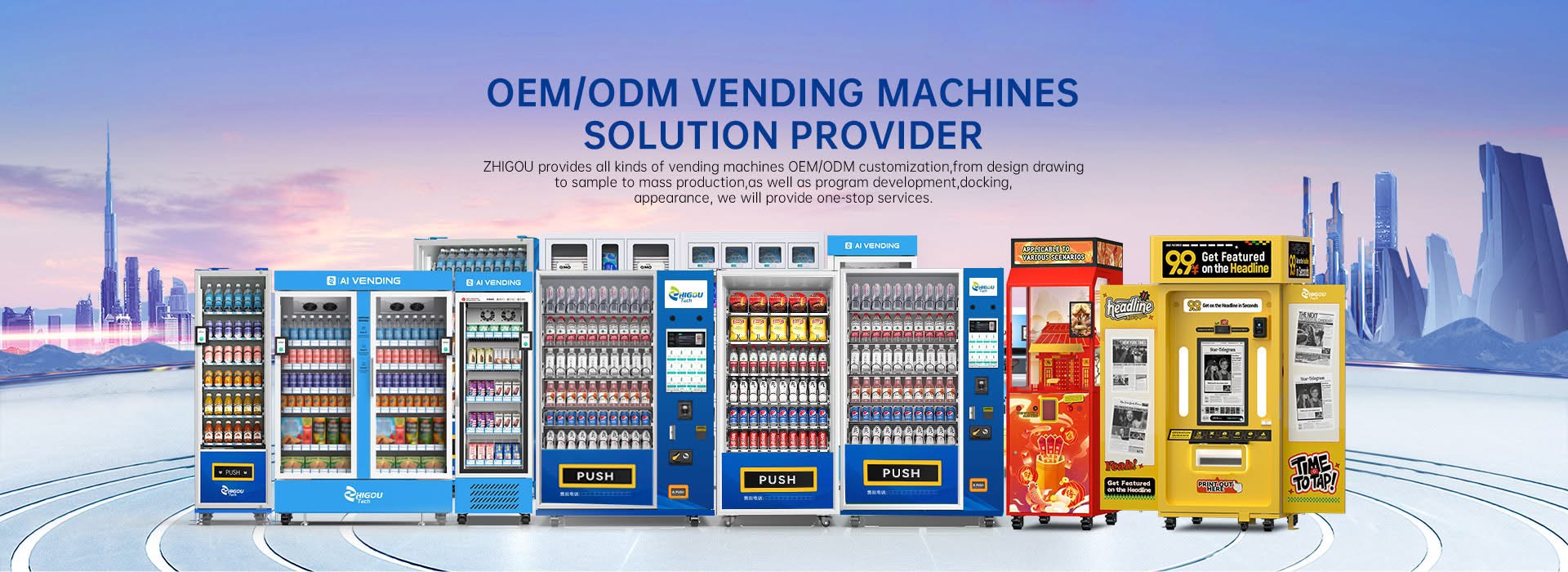
[Zhigou Tech](https://zhigouvendingmachine.com/) lists spiral vending machines, AI vision smart vending cabinets, and payment-module customization among its offerings. Those options provide a starting point for discussing your intended setup; they do not mean every model supports every processor or that the manufacturer can guarantee a lower merchant rate.
For a useful proposal, share your target country, machine format, product-price range, expected basket size, and preferred payment provider. Request written confirmation of the proposed reader configuration, included services, recurring charges, and responsibilities for payment faults. This connects equipment selection with the operating costs you are trying to control.
## Frequently asked questions
### Can a one-machine operator negotiate vending machine card processing fees?
Yes. Ask for a pricing review and whether a more suitable plan or removal of an unused service is available. The provider may decline a discount. Judge the result by the total bill and required functionality, not the size of the percentage reduction alone.
### How many machines do I need before a provider will negotiate?
The sources reviewed do not establish a universal threshold. Ask the provider to specify the relevant volume, ticket size, account, or deployment criteria in writing. Machine count without actual processing activity is an incomplete measure.
### Is interchange-plus always cheaper than a flat rate?
No. Compare the expected pass-through charges, markup, per-transaction amounts, monthly minimums, and service fees using the same transaction history. More itemization can improve visibility without guaranteeing a lower total.
### What if my provider refuses to reduce the rate?
Ask when the account can be reviewed again and what would change eligibility. In the meantime, check service charges and obtain a compatible alternative quote. Switch only after pricing the contract exit and implementation costs.
### What should I ask for first?
Ask for a written simulation of vending machine credit card fees under the proposed tariff applied to your actual recent transactions, together with every required recurring fee. That gives you a concrete basis for deciding whether the proposal improves the business.